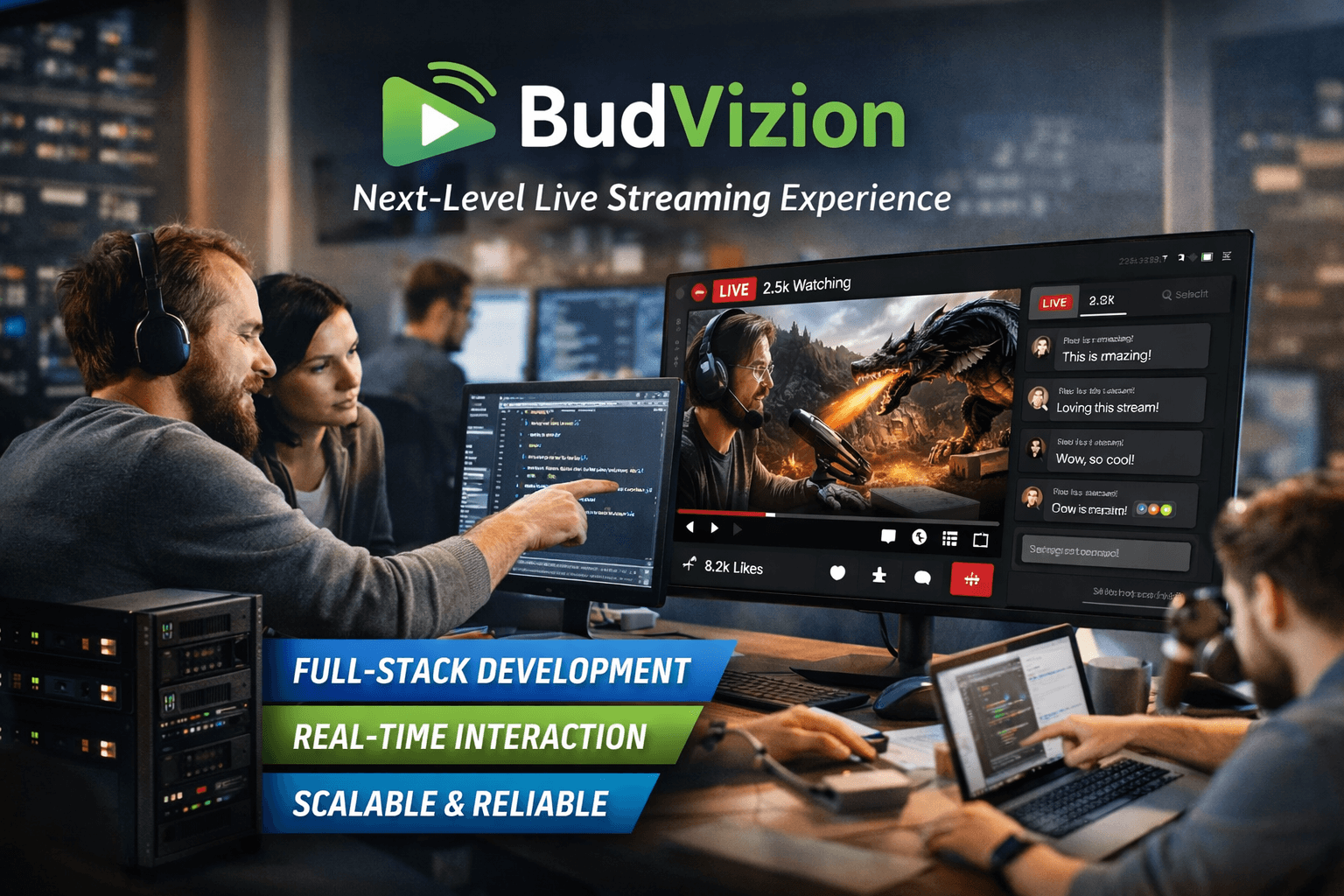
1. Introduction: The Live Streaming Frontier
The live streaming industry is currently undergoing a radical transformation. While traditional streaming relied on HLS (HTTP Live Streaming) which introduced delays of up to 30 seconds, modern users demand instantaneous interaction. Latency is the enemy of engagement. In a world where real-time feedback defines the user experience, building a platform that remains stable under heavy concurrency while maintaining sub-second latency is a formidable engineering challenge.
BudVizion was engineered with a clear purpose: to bridge the gap between high-quality broadcast and real-time social interaction. This isn't just about pushing pixels; it's about synchronization, state management, and resilient system architecture. In this deep dive, we’ll explore the technical decisions, challenges, and implementation details that define BudVizion as a scalable, production-ready live streaming solution.
2. The Vision Behind BudVizion
When we conceptualized BudVizion, we saw a fragmented market. Most platforms either prioritized high-quality feed (with high latency) or poor-quality interaction (with lower stability). Our vision was to create a unified ecosystem where streamers could interact with their audience as if they were in the same room, regardless of global distance.
We didn't just want a "streaming app"—we wanted a social infrastructure. This meant focusing on three core pillars: Ultra-Low Latency, High Interactivity, and Uncompromising Reliability. Our long-term vision is to scale this into a multi-region, 4K-supported infrastructure that powers the next generation of digital creator economies.
3. System Architecture Overview
BudVizion's architecture is built on a modern, full-stack foundation designed for speed and maintainability.
The Frontend Stack
We chose Next.js and React for our frontend, utilizing TypeScript for type safety across our complex real-time state. The UI architecture follows a atomic design pattern, ensuring that individual components like the stream player, chat box, and viewer indicators are reusable and independently testable. Tailwind CSS provided the utility-first styling needed for a responsive, performant interface that feels "glassy" and premium.
The Backend Infrastructure
Our primary API layer is built with Node.js and Express, following a RESTful architecture. Authentication is handled via secure, industry-standard protocols, ensuring that user data and stream access are protected. The database structure is optimized for high-read scenarios, particularly for user profiles and stream metadata.
Real-Time Communication Layer
The heart of the system is the Agora SDK (RTC + RTM). Rather than building a custom WebRTC implementation from scratch, we leveraged Agora's global Software Defined Real-time Network (SD-RTN). This allowed us to focus our engineering efforts on the application-specific logic, token management, and interactivity rather than low-level networking hurdles.
4. Engineering Real-Time Streaming (RTC)
Integrating the Agora RTC (Real-Time Communication) SDK required a deep understanding of stream lifecycles. We implemented a robust host-viewer architecture where the transition between states is seamless.
Secure Token-Based Authentication
Production security is non-negotiable. We implemented a backend service that generates dynamic RTC tokens. Every time a user joins a stream, our frontend requests a time-limited token from the server. This prevents unauthorized users from hijacking stream channels and ensures that only authenticated participants can publish or subscribe to feeds.
Stream Lifecycle Management
We meticulously managed the stream lifecycle:
- Join: Pre-calculating connection parameters to minimize "black screen" time.
- Leave: Ensuring all local resource cleanup (cameras, microphones, event listeners) occurs to prevent memory leaks.
- End Stream: A critical event. When the host ends a session, the system must broadcast a termination signal to all connected viewers instantly.
Optimization Strategies
To optimize latency, we configured the SDK for Low Latency mode and implemented intelligent region selection. By connecting users to the nearest edge location in the Agora network, we successfully maintained sub-500ms latency even in cross-continental sessions.
5. Handling Real-Time Messaging (RTM)
Video is the platform, but messaging is the engagement. We integrated Agora RTM to power our interactive features.
The Real-Time Chat System
Our chat system isn't just a list of messages. It’s a high-concurrency messaging engine. We optimized message rendering to prevent UI lag during "chat storms." By using a virtualized list and efficient state updates, we ensure that a stream with 10,000 active chatters feels as smooth as a stream with ten.
Presence & Signal Events
Using RTM, we built a presence handling system that tracks who is currently in the room. Beyond chat, we use Event-Based Communication to handle:
- Host Notifications: Instantly notifying viewers when the host changes a camera or shares a screen.
- Stream End Detection: While the media stream might stop, the RTM layer ensures the UI updates immediately to show a "Stream Completed" screen, avoiding confusing loading indicators.
6. Performance, Optimization & Reliability
Fast Join & Reconnection
We implemented a "Warm-Up" strategy where the connection handshake begins as soon as the user hovers over the stream card. This makes the transition into the live room feel instantaneous. For users on unstable networks, we built a Exponential Backoff Reconnection Strategy that gracefully attempts to re-establish the stream without forcing a page refresh.
Reliability and Defensive Coding
In a real-life environment, things go wrong. Hosts lose internet, browsers crash, and servers restart. Our Failover Thinking includes:
- Auto-Navigation: If a host's RTM connection drops unexpectedly, the server-side watchdog detects the inactivity and redirects viewers to the homepage.
- Defensive Error Handling: Every SDK call is wrapped in comprehensive try-catch blocks with custom error reporting, allowing us to debug edge cases in production rapidly.
7. Security & Production Readiness
Data & Access Security
We strictly follow Role-Based Access Control (RBAC). A viewer can never "accidentally" gain host privileges because the backend validation is independent of the frontend state. All environment variables (API keys, App IDs, Secrets) are managed through secure production environments, never exposed in client bundles.
Deployment Workflow
Our production readiness is backed by a professional Git Workflow. We use a branching strategy (feature -> develop -> main) with continuous integration. Every production build undergoes a rigorous optimization process where unused code is tree-shaken, and assets are compressed to ensure the fastest possible Initial Page Load.
8. Team Collaboration & Learnings
Building BudVizion was a masterclass in modern team collaboration. We utilized agile methodologies, breaking down the complex real-time requirements into manageable sprints. Task distribution was based on domain expertise: I focused on the MERN stack integration and real-time state, while receiving critical architectural mentorship from Muhammad.
Key Engineering Lessons
- Real-time is hard: Synchronization across disparate clients with varying network speeds is the biggest challenge.
- State Management is key: In a live system, the "Source of Truth" must be highly disciplined. We learned that over-managing state leads to complexity, but under-managing leads to desynchronization.
- Iterate on UX: We simplified the join flow three times based on performance data before reaching the current "instant" feel.
9. Future Roadmap
We are only getting started. The roadmap for BudVizion includes:
- Advanced Moderation: AI-powered content filtering and automated reported-event handling.
- Comprehensive Analytics: A streamer dashboard showing real-time engagement heatmaps and retention data.
- Monetization Layer: Integrating secure payment gateways for virtual gifting and subscriptions.
- CDN Scaling: Moving beyond the core RTC network to include edge-caching for post-stream VOD (Video on Demand) content.
10. Conclusion
BudVizion is the result of focused engineering and a commitment to solving the real-world problems of live interaction. By combining the power of the MERN stack with the global reach of Agora, we have built more than just a platform—we’ve built a doorway to real-time digital excellence. As we continue to scale and innovate, our focus remains the same: engineering systems that are as resilient as they are interactive.
*Written by Muhammad Mudasir, MERN Stack Developer at QuantAeonix.*