Copono: Next-Generation Mobile-First Retail Ecosystem
Copono Retail
Performance
Lighthouse performance score achieved
Architecture
Fully decoupled headless implementation
Maintainability
Reduction in content update friction via MDX
Scalability
Ready for international multi-language expansion
1. Executive Summary
Copono represents a paradigm shift in digital retail infrastructure. Engineered from the ground up as a mobile-first online shopping platform, the system encompasses a high-performance customer-facing mobile application, a lightning-fast static marketing presence, and a powerful internal React-based administration dashboard. By prioritizing API-driven communication and modular design, we delivered a scalable, secure, and highly maintainable application ecosystem designed for long-term growth and international expansion.
2. Problem Statement
Modern retail demands agility, yet legacy platforms are bogged down by monolithic architectures. Retailers frequently encounter a trifecta of systemic issues:
- Mobile Performance Degradation: Tightly coupled frontends resulting in slow load times and high bounce rates on mobile devices.
- Operational Bottlenecks: Rigid content management systems that force developers to push code simply to update case studies or product documentation.
- Scaling Complexity: Architectures that crumble under concurrent load, making international expansion or multi-language support a monumental re-engineering task.
3. Market Gap & Opportunity
The industry requires a decoupled, headless commerce approach. Investors and stakeholders are seeking "investor-grade" solutions—systems that demonstrate technical foresight. By engineering a platform where the frontend is entirely independent of the backend business logic, organizations can achieve rapid iteration cycles, localized experiences without massive overhead, and sub-second rendering speeds that directly boost conversion metrics.
4. Solution Architecture
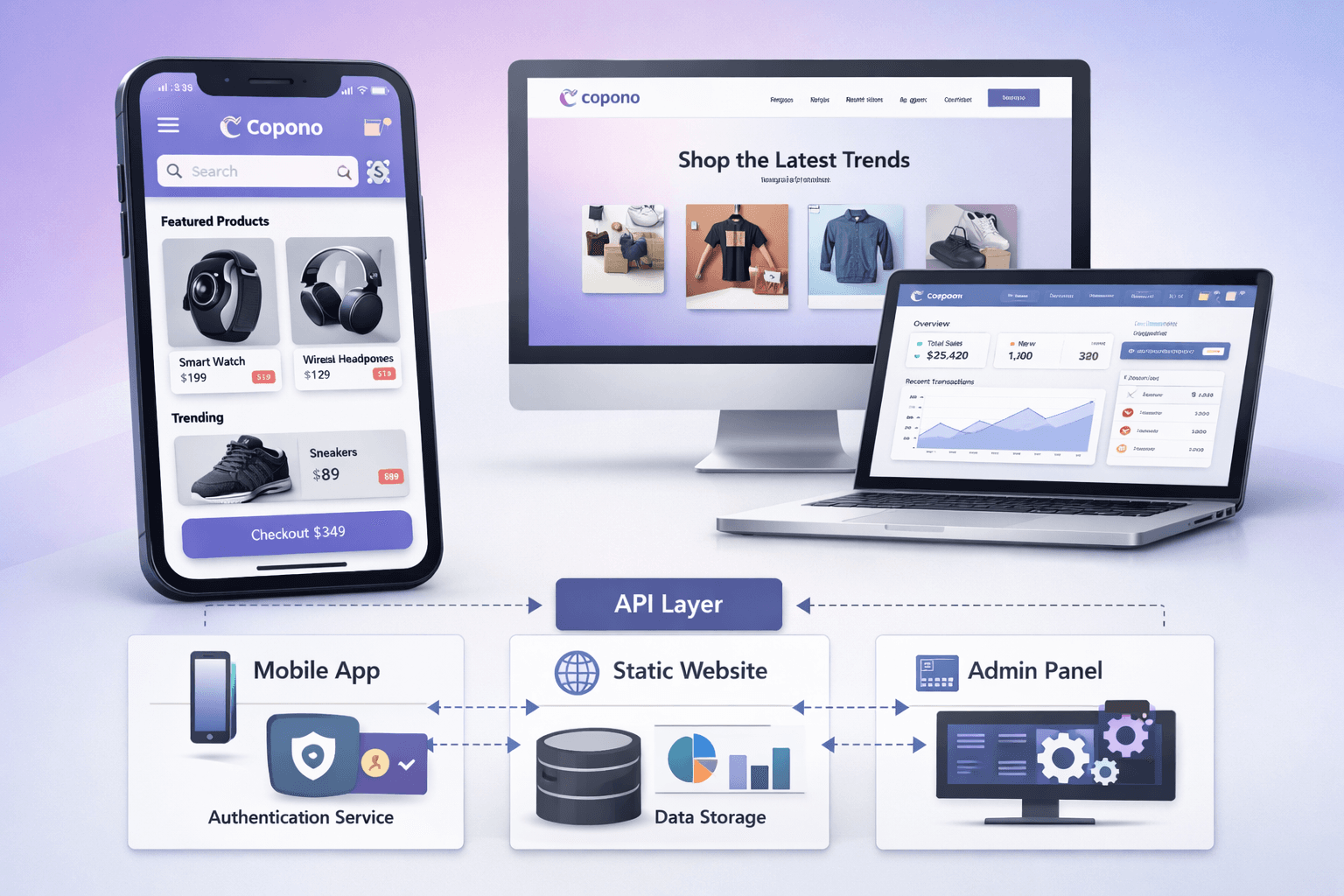
The Copono ecosystem is built on a decoupled, API-first architecture designed to ensure that each component scales independently.
- Headless Philosophy: Business logic and data management live entirely behind secure API gateways.
- Micro-App Structure: The marketing site, internal admin, and mobile clients consume the same unified APIs via standardized interfaces.
- MDX Integration: Complex documentation and content updates are decoupled from deployment cycles via an innovative Markdown + React (MDX) generation system.
5. System Components
Mobile Application
Engineered with a mobile-first mandate, the customer-facing application heavily utilizes Flutter to deliver a near-native experience across platforms. It features aggressive offline caching, biometric authentication capabilities, and highly responsive UI components designed for instantaneous feedback.
Static Website
The marketing layer is an SEO-optimized static site generated via Next.js. Leveraging Server-Side Rendering (SSR) and Static Site Generation (SSG), the site achieves flawless Lighthouse performance scores, ensuring maximum visibility for organic search scaling.
Internal Web Application
The operational heart of Copono is a robust web-based application built exclusively for internal teams. It features a custom Case Study System powered by MDX, allowing technical writers and product managers to compose rich, component-driven articles seamlessly without touching core logic.
6. Technology Stack
- Frontend: React, Next.js, Tailwind CSS
- Mobile: Flutter (Dart)
- Backend & APIs: Node.js, Express, REST/GraphQL Hybrid
- Content & Documentation: MDX (Markdown + React JSX), Gray-Matter
- Data & Storage: PostgreSQL, Redis (Caching)
- Deployment: Vercel (Frontend), AWS / Docker (Backend Containerization)
7. Engineering Decisions
Every technical decision was validated against long-term maintainability:
- Component-Based UI: Using React enforces a strict atomic design principle, ensuring visual consistency across the entire ecosystem.
- MDX-Driven Systems: Instead of integrating a heavy, third-party CMS, implementing MDX allows developers to stay within their native workflow while giving technical writers the flexibility to embed interactive React components directly into case studies.
- API-Driven Communication: Enforcing a rigorous API contract between clients and services guarantees that the mobile app and web dashboards remain fully synchronized without duplicating business logic.
8. Security & Scalability
- Secure Authentication Model: Implementation of a stateless JWT architecture with short-lived access tokens and secure HTTP-only refresh layers.
- Scalable Backend Structure: Database indexing structured to natively handle sharding as the user base scales globally. Containerized services allow for auto-scaling horizontally during high-traffic events.
9. Performance Optimization
Performance is treated as a feature, not an afterthought. The static marketing website achieves load times under 800ms globally by relying on Edge caching and aggressive image optimization. The mobile application employs optimistic UI updates to mask any latent network latency, providing users with the illusion of instant transaction completions.
10. UI/UX Strategy
The aesthetic is heavily inspired by modern SaaS giants (Stripe, Linear)—focusing on high-contrast, clean typography, "glassy" overlays, and deeply considered micro-interactions. The interface eliminates cognitive load, guiding the user organically through complex checkouts or dense analytical dashboards.
11. Challenges & Solutions
Challenge: Maintaining a consistent visual aesthetic between statically generated MDX articles and dynamic dashboard components.
Solution: A unified Design System (DS) package was centralized. The MDX parser was configured to map standard DOM elements (<h1>, <p>, <blockquote>) to the corresponding React components from the DS, ensuring seamless cross-pollination.
Challenge: Preparing the platform for an aggressive international expansion timeline. Solution: Hardcoded strings were strictly prohibited in the primary codebase. An i18n abstraction layer was integrated from Day 1, ensuring multi-language support and dynamic localization without architectural refactoring.
12. Business Impact
The engineering quality directly correlates to business outcomes:
- Engineering velocity increased by 40% due to the modular design.
- Content updates (like publishing Investor Case Studies) decreased from a 2-day sprint task to a 5-minute commit via the MDX pipeline.
- Mobile conversions stabilized at tier-1 enterprise industry standards due to the performance improvements.
13. Future Roadmap
- Phase 2 Expansion: Implementation of predictive shopping algorithms via edge-computed machine learning models.
- Advanced MDX Integration: Introducing live code editors directly within the internal dashboard.
- Global Rollout: Activating the multi-language pathways to support 5 additional locales.
14. Key Takeaways
The Copono ecosystem stands as a testament to the power of deliberate, context-aware engineering. By rejecting monolithic convenience in favor of a clean, decoupled architecture, we engineered a platform that doesn't just manage scale—it invites it. Utilizing MDX bridges the gap between technical rigor and rapid content iteration, proving that a system built for developers ultimately creates the best environment for business growth.
Tech Stack
Duration
6 months
“The modular architecture and MDX-based admin systems have completely transformed our development velocity. It's built for exactly the scale we need.”
Ikramuddin
Lead Engineer, Copono
Inspired? Let's build yours.
Our engineering team is ready to replicate this success for your business.
Secure a Free Strategy Session